

Sombr spaces
Or, some thoughts about teenagers, the internet, and the right to talk online trash

Being on the West Coast means that every so often, I’ll wake up, check my news feeds and find that my social media feed is in total book club mode over a spicy journalistic op-ed that came out overnight. It’s been an utter delight to see it happen to my once-Guardian colleague Chante Joseph with the now infamous Vogue piece “Is Having A Boyfriend Embarrassing Now”, but a couple of months back it also happened with Kelefa Sanneh’s New Yorker piece, “How Music Criticism Lost It’s Edge”. “When I was growing up, a critic was a jerk, a crank, a spoilsport.” he writes:
“on blogs, you could draw a crowd with a contrary opinion, but on social media you became a ringleader by saying things that your followers could publicly agree with. As the magazine world shrank, much professional reviewing was done not by all-purpose critics like [Robert] Christgau, who covered just about everything, but by freelancers, who might be assigned reviews based on their affinity for the performer, which created a built-in positive bias. The virtual intimacy of social media slowly erased the distinction between talking about somebody and talking to them.”
I wrote extensively about social media, stan culture and our growing obsession with metrics-as-musical success in a previous newsletter, and so I didn’t necessarily think I had much to add to the conversation that hadn’t already been said. Eric Harvey made the point that the supposed glory days of biting criticism were a total misogynistic sausage fest1, while Jill Mapes (co-founder of the excellent new platform, Hearing Things) argued that if editors want more incisive criticism, they need to figure out strategies to help protect their writers from the wrath of dissenting publics who see fit to seek out their home address and threaten their lives. Steven Hyden wrote a really good newsletter about how a fixation on the decline of mass media often ignores the amazing stuff coming out of the grassroots, whilst numerous others pointed out that at a time where the world feels terrible, careers are precarious and music journalists are mostly working invoice-to-invoice as freelancers, it’s not entirely surprising that they might be more motivated to pitch stories about artists and work that they’re excited about rather than stuff that they’re not. Regardless, Sanneh’s words on virtual intimacy and criticism have lingered for me as I ponder the ongoing tensions between stars, stans and scribes2, and arose yet again in relation to the evolving news coverage around Sombr, one of 2025’s most notable breakout artists.
If you haven’t yet heard of Sombr or his music, allow me to offer a brief primer. Born Shaun Michael Boose in the autumn of 2005 to parents with their own demonstrable ties to the entertainment industry, the New Yorker’s music had been bubbling for a while but rocketed to teen-sensation territory in March of this year, when ‘Back To Friends’ and ‘Undressed’ both did absolute bits on TikTok. According to Vox writer Jason P. Frank, “Sombr is a Timothée Chalamet lookalike rock singer, who sounds a little like The 1975 got put through the washing machine and all its big, even sometimes annoying, ideas got shrunken down into a TikTok-sized package”. To my ears, you could also think of him as a child of the 2011 Tumblr/Foster The People/Fun/Cigarettes After Sex aesthetic, sold in the section of Urban Outfitters where they re-press retro T-Shirts via screenprint so that they don’t have to splash out on the cost of more detailed embroidery.
Coming from a 30-something with less than 70 Substack followers, that probably sounds unnecessarily mean and specific (and we’ll come back to the ‘skill issue’ idea of meanness soon). But it’s worth making clear upfront that I don’t really see the plainly-worn nature Sombr’s influences as being problematic to his overall proposition. When I was in my late teens/early twenties, I always resented the notion that I had to appreciate the respectable ‘original’ rather than the version that felt closer to the life and times I was living in. Sure I’d get around to loving the Beatles, but if Panic At The Disco’s ‘Pretty. Odd.’ was the vehicle to get me there, who is to say that didn’t count?3 Not everything has to be of life-changing quality to be enjoyable, and if I was 14 years old and just starting to really hone my own musical tastes independent of my parents, I can totally see a world where ‘12 to 12’ would be spinning on the Crossley speaker that I’d saved my birthday and Christmas money to buy. Teenagers deserve their own popstars and their own entry points to enjoying music.
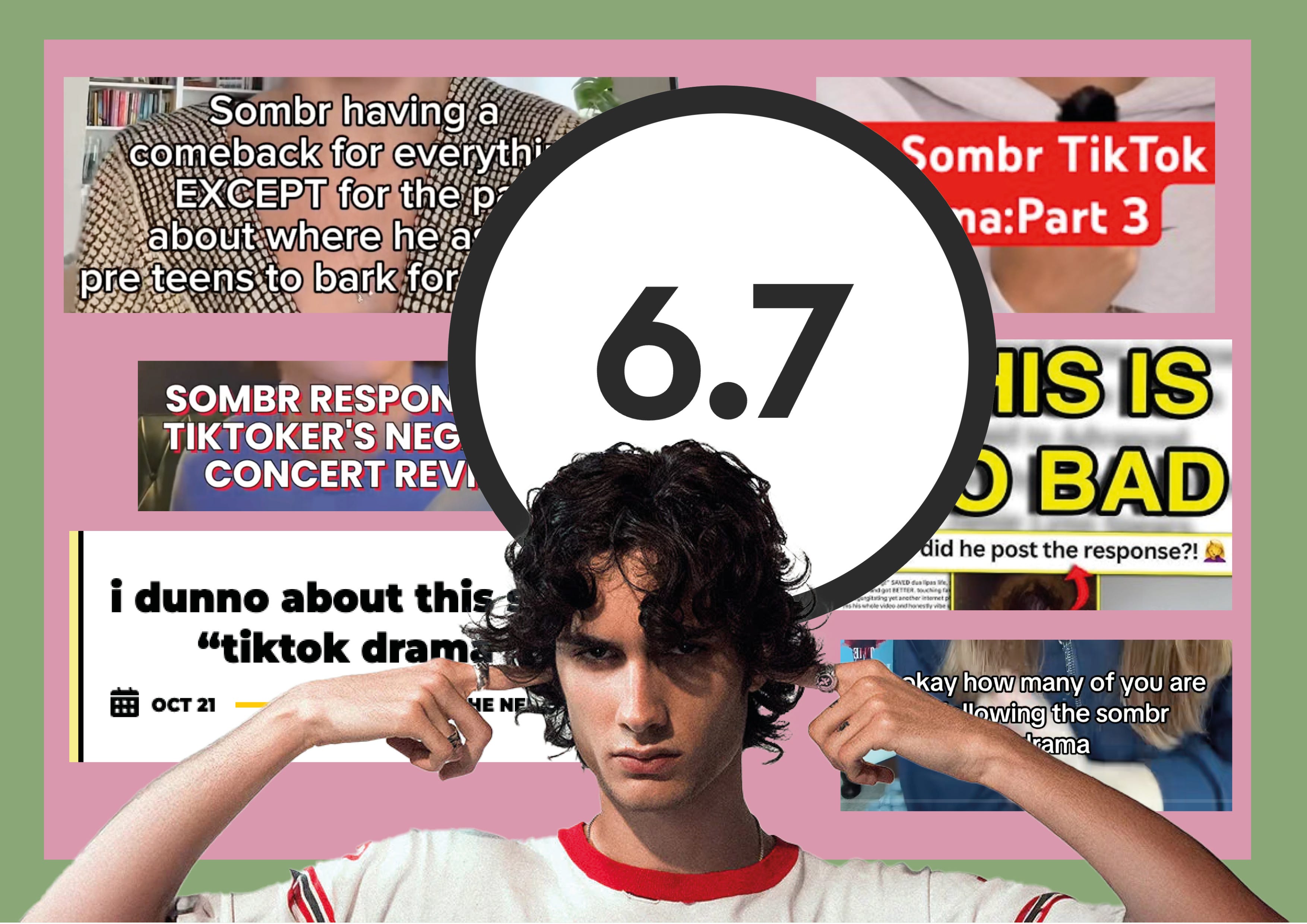
The actual issue that artists like Sombr are experiencing, however, is that in becoming known through the internet, their music is being marketed through multi-generational channels, where everybody feels entitled to claim their own stake, and even more emboldened to have their say, reifying the conversation around ‘criticism’ as a digitally-problematised form. Last month, a TikTok user went low-key viral when she posted a storytime of her attendance at a Sombr concert, which she described as“genuinely the worst performance I’ve ever seen in my life”. Referring to him as “slenderman”, this user called him out for making sexual jokes, and described “thousands of tweens running around like they were at a middle-school dance.” In response, Sombr recorded his own viral video, in which he offered up instruction for the original poster to touch grass:
“it’s kind of started a massive body shaming hate train directed towards me on a lot of videos of me on the internet right now…I totally respect people having opinions, but I am a 20-year-old artist, freshly 20. And if you’re 25 years old and you’re going to come to my concert and not expect people younger than you to be there, when I the artist am five years younger than you, it’s just a skill issue… Live a little, enjoy life…you guys need to find problematic people to hate on, because I am just existing.”
 Tiktok failed to load.
Enable 3rd party cookies or use another browser
Whilst a non-event to some, this exchange to me felt like an interesting sign of the moment we’re living in, and one worth eking out. The nature of streaming and de-personalised ‘trending audio’ TikTok discovery explains how easy it might be to find and like somebody’s music without necessarily releasing who they are or how they perform. But much like the ‘disgusted parent of young daughters’ criticism of Sabrina Carpenter tour attendees earlier in the year, I do think it’s somewhat on you if you have the money to drop on a concert ticket in 2025 without at least paying some due diligence to the artists age or general onstage demeanour. As a “freshly’ 20-year-old, Sombr is extremely online, and by his own admission, that means stupid jokes, ranging from iterations of the 6,7 meme to a segment of his show where he invites a fan up to ‘call out’ their toxic ex.
On one hand, some of the things Sombr is saying at his shows are cringe and infantile, but also firmly in keeping with his peers (and indeed, the kind of boisterous toilet gags that plenty of millennials would have experienced at their own 5SOS/Busted/McFly/Blink-182-type shows growing up. Targeted comments about his appearance are pretty irrelevant to topic at hand, and disparaging comments about tweens behaving well, like tweens, reads as massively punching down. But on the other, and echoing the words of one TikTok commentator, I do also “think it’s weird that [Sombr] can acknowledge that the age gap between 20 and 25 might be a big one, but can’t acknowledge that the age gap between him and his fans - [who are] 12/3 - might be too big for him to be at his concert telling them to bark and call him daddy.” By largely avoiding the concerns of inappropriate sexual behaviour and power imbalance at his concerts, Sombr’s TikTok response has done little to shift some critics image of an immature, nepo baby fratboy recycling old musical trends. And by acting as if 25 is somehow ancient4, claiming he isn’t bothered when he patently is and by tagging his ‘hater’ in such a way that fans had all the info they needed to find her for themselves, he recalls the mishandlings of Alex Warren or Benson Boone before him, where direct-quoting your critics only serves to draw additional attention to the criticism.
There’s a simpler, much more human undercurrent to all of this. Whether you’re a TikToker on a throwaway account or a fully-fledged, 3000-words-a-week journalist, negative reviews hurt. Reviews that offer up a nugget of truth or probe personal insecurities hurt even more. It’s why artists get so upset by relatively middling Pitchfork reviews (nothing feels worse than indifference), and why they seem committed to lurking their online communities for feedback even when they know it’s liable to show up things that will make them feel sad or mad or dehumanised. If fan discussions are happening on the same social media platforms that artists are told they have to be on for their jobs (as opposed to say, niche forums or fan-made invite-only discussions, or maybe even a good old-fashioned fan meet ups), then how strong and assured do you really have to be to resist the urge to scroll? If fans feel so emboldened to love you one minute then slag you off the next, how hard is it to resist the urge to exercise your same right of speech?
Though social media is far from the platform-democratising utopia it was once billed as, having an internet connection does mean having a channel to broadcast your opinion. Even if it means using hyperbolically-nasty comments about someone that you professed to loving eight tweets ago, there’s technically fair game to simply say whatever you like on ‘your’ space of the internet, not predicting the ways it might travel. In an attention economy, artists know that vocally pushing back against haters helps to maintain the kind of underdog mentality that fuels passionate cult fandoms5, whilst critics and small content creators alike know that if they make a barbed comment about a celebrity and get known for it, they can always throw their hands up in the air and say that it was never their intention for it to reach the artist and that the artist should simply learn to grow a thicker skin. Both parties get to feel like they have the all power, but they also have equal right to claim powerlessness when things don’t go their way.
At the heart of this debate though — and to to my mind, the even bigger issue in the case of Sombr — is that teens and adults (yes, even geriatric 25 year olds) were never truly meant to share the same social spaces, online or otherwise. We’re not supposed to be annoyed by 6.7 jokes, because we’re not even supposed to know what they are. We’re not really supposed to be making TikToks about finding teenagers annoying at the concert, because it wasn’t necessarily a concert we would have known to be at. Pointing out a pipeline between cringey online humour and active misogyny can be valuable, but when done without any appropriate context or empathy, it also risks fuelling an ‘us vs them’ mentality that only encourages kids to double down on the thing that feels like rebellion.
Teenage music lovers should still be able to look to fanzines, magazines and Club Penguin-type teen-centric forums for the bulk of their pop culture sociality, rather than hashing it out in the same reddits or tiktoks or twitters that are open-ground hunting season for adults to harvest bad takes and quote-post them as evidence of how stupid and parasocial today’s teens are. Teens deserve spaces where they can experiment with sexuality and humour and self-expression in an age-appropriate way, without the mixed online messages that force them to both grow up too fast and face being mocked for being immature. They deserve to read publications that offer a genuine unpatronising insight into the world, but also know how to present that content in a responsible way (such as the recent and deeply-egregious absorption of Teen Vogue). Sure, there’s no age limit on liking an artist’s music or wanting to see them live, but rather than chiding teens for camping culture or meme humor, we need to recognise that a lot of time, we behaved that way too at their age but lucked out on the ability to try things and screw up without them being immortalised online as evidence of our immoral form. If, in the Kelefa Sanneh’s words, “the virtual intimacy of social media slowly erased the distinction between talking about somebody and talking to them”, then maybe we all need to think a little more about our motivations in entering that discussion, the forums in which we decide to have them, and whether a return to longer-tailed, slower paced, deeply-considered music criticsm — snarky or otherwise — might break this loop where everybody feels the pressure to talk in such total absolutes.
In other thoughts:
Watching: Fall is Reality TV season, but whilst we’re talking about music, I really enjoyed Hitmakers on Netflix a few weeks back. In fact, I’m quite surprised more people haven’t been talking about it. It’s that same comfortingly-shclocky format where ‘so and so said this about you behind your back’ is the main thrust of the constructed drama, but it also picks apart the alchemy of writers camps and the dynamics of putting a commercial song together in quite insightful and interesting ways. It’s also quite a nice respite from Selling Sunset, which I normally love but found to be utterly humourless this season; all the villainy but with no pantomime fun.
Reading: I’ve been reading a ton of fiction recently, but in the past couple of months I particularly loved Woodworking by Emily St James, Rejection by Tony Tulathimutte and The Wedding People by Alison Espach: all offering up intensely rich character building with just the right touches of surrealist or self-deprecating humour. My library hold also came in clutch on Matriarch by Tina Knowles; I inhaled the first 150 pages on the first night before bedtime and did the same every evening until it was done. Obviously the bits about raising Beyoncé and Solange are the big sell, but I was totally spellbound by the passages about her own childhood, particularly around the notion of race and racism in the south. I really hope she writes more.
Listening: I’m still very much stuck in Hayley Williams purgatory (and crashing out/crying hard over having failed to win the ticket war), but I’m looking forward to watching Jay Som play live this week as a way to ease my pain. The new KeiyaA record is also soothing some of my woes: think jazz meets RnB meets slam poetry.
A deeply romanticised sausage fest no less - when I started a music journalism degree in 2011, Lester Bangs book was pretty much the only compulsory reading. Granted, the landscape of music criticism books wasn’t as abundant as it now, but all of my instructors were male, and very little was done to purposefully introduce us to the work of the highly visible female writers that could have been drawn upon - Ellen Willis, Jessica Hopper, Ann Powers, etc.
See also Spencer Kornhaber’s own deep dive on music criticism and fan culture “Traditional Criticism Is in Trouble. Here’s What’s Replacing It”
Do yourself a favour, put ‘Northern Downpour’ on, and tell me that you don’t feel something.
Amusingly, I also run into this issue with my students sometimes, who can’t fathom that when I talk to them about K-Pop or Charli XCX, it’s because I actually like it too, rather than that I’m making some desperate attempt to manipulate them into thinking I’m cool. I guess I probably felt the same at their age, but boy is it rough to be on the other side.
As Indigo De Souza might recently attest, this can definitely also backfire.
A lot of great points here. As a recent Sombr listener myself (I burned through his "I Barely Know Her" in maybe 3 weeks, some great pop bangers all-in-all), this was a very insightful read. Thank you!
But I actually decided to leave a comment also because I'm currently reading "The Wedding People" (very light, summery read, but nonetheless it's well written) and am really curious if "Rejection" is worth a read? Tulathimutte's book has been on my watch for a while now
really loved your point about the overlapping of online spaces; i think about this so often, and have to remind myself that we're not supposed to know everything!